What Do Palo Santo Incense Cones Smell Like?
Palo Santo-inspired incense is usually associated with a warm, dry and distinctive woody aroma.
Common scent impressions include:
- woody
- earthy
- gently sweet
- lightly citrus-like
- resinous
- softly smoky
Some people also notice hints reminiscent of pine, lemon or mint.
Fragrance perception varies, and incense cones may smell somewhat different from burning raw Palo Santo wood.
What Is Palo Santo?
Palo Santo means “holy wood” in Spanish and is a common name associated particularly with Bursera graveolens, a tree native to parts of South America.
The wood and resinous aroma have been used in cultural and spiritual practices in regions including Peru and Ecuador.
Palo Santo belongs to the Burseraceae plant family, which also includes plants associated with frankincense and myrrh, although these are different species with distinct histories and traditions.
These incense cones are best understood as a Palo Santo-fragranced incense product rather than automatically being equivalent to burning traditionally harvested Palo Santo wood.
Palo Santo & Spiritual Cleansing
Palo Santo has become strongly associated with cleansing and purification in contemporary spiritual practice.
People may use its aroma while:
- preparing a meditation space
- beginning a personal ritual
- journalling
- setting intentions
- practising yoga
- reflecting
- creating a calm atmosphere
Descriptions of Palo Santo “clearing negativity” or “purifying energy” belong to spiritual and symbolic traditions rather than scientifically established effects.
Cultural Respect
Palo Santo has genuine cultural and spiritual associations in parts of South America.
Modern commercial products sometimes generalise those traditions or present Palo Santo as a universal “healing wood”.
It is better to recognise that practices vary by region and community and to avoid implying that every modern incense product carries the same ceremonial meaning as traditional use.
These cones are a home-fragrance and spiritual-practice product inspired by Palo Santo aroma and symbolism.
Palo Santo for Meditation
The warm woody fragrance of Palo Santo incense can work well as an atmospheric backdrop for meditation.
You might burn a cone before:
- seated meditation
- breathing practice
- journalling
- yoga
- personal prayer
- quiet reflection
- intention-setting
Scent can help create a consistent ritual atmosphere, but the incense itself does not guarantee calm, concentration or spiritual insight.
What Are Dhoop Incense Cones?
Dhoop cones are compact incense cones designed to smoulder and release aromatic smoke without the bamboo core found in many incense sticks.
Their compact form can produce a relatively concentrated fragrance.
They are generally burned upright on a suitable heat-resistant incense holder or dish.
This is different from backflow incense cones, which are specially manufactured to direct smoke downward through a compatible burner.
Dhoop Cones vs Backflow Cones
Standard dhoop cones and backflow cones are not interchangeable in terms of visual smoke effect.
Dhoop cones:
- usually release smoke upward
- work with standard heat-resistant incense holders
- are intended primarily for fragrance
Backflow cones:
- contain a channel or opening through the base
- are designed for compatible backflow burners
- create a downward “waterfall” smoke effect
These Palo Santo cones should not be assumed to produce a backflow effect unless specifically labelled as backflow cones.
How to Burn Palo Santo Incense Cones
To use:
- Place the cone upright on a stable, heat-resistant incense holder or dish.
- Light the tip with a match or lighter.
- Allow the flame to burn briefly.
- Gently blow out the flame.
- Check that the tip is glowing and producing smoke.
- Allow the cone to smoulder naturally.
Ash and heat can damage surfaces, so always use a proper incense holder.
Cone Incense vs Incense Sticks
Cone incense often produces a more concentrated fragrance over a smaller area than incense sticks.
Some people prefer cones because they:
- are compact
- do not use a bamboo core
- work well in small ritual spaces
- produce a rich fragrance
- are easy to use with simple holders
The choice between incense cones and sticks is mainly one of fragrance style, burn behaviour and personal preference.
Palo Santo & Relaxation
Palo Santo fragrances are often described as calming or grounding because of their warm woody character and association with meditation.
It is more accurate to say that the scent may help create a relaxing-feeling atmosphere rather than claiming that it directly reduces tension, anxiety or stress.
Individual responses to incense fragrance vary considerably.
Palo Santo & Health Claims
Palo Santo is sometimes promoted online as a natural remedy for anxiety, inflammation, colds and other conditions.
Those claims should not be carried over to this incense product.
Burning incense produces smoke and particulate matter, so these cones should be used for fragrance and spiritual atmosphere rather than as a medical or respiratory treatment.
Incense Safety
Always burn incense carefully.
- Use a stable, heat-resistant holder
- Keep away from curtains, paper and other flammable materials
- Burn only in a well-ventilated area
- Never leave burning incense unattended
- Keep away from children and pets
- Avoid breathing smoke directly
- Allow the holder to cool before touching
- Make sure the cone is fully extinguished after use
People who are pregnant, have asthma, respiratory conditions or fragrance sensitivities may wish to seek appropriate professional advice before using smoke-producing fragrance products.
Natural Ingredients
The supplied information describes these cones as made with natural ingredients.
However, unless the current manufacturer packaging provides a full ingredient declaration, I would avoid specifying exact flowers, resins, herbs or essential oils.
Incense formulations are often proprietary and may vary between manufacturers or batches.
Disclaimer
Descriptions relating to cleansing, grounding, meditation or spiritual purification are based on traditional and contemporary spiritual practices and scent associations.
They should not be interpreted as medical, psychological or scientifically established effects.
Incense is intended for fragrance and atmosphere and should always be burned with adequate ventilation.




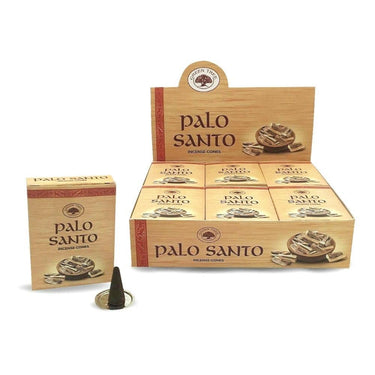

 Palo Santo Incense Cones 10 Pack - Dhoop Cones for Meditation & Cleansing
£1.35
/
Palo Santo Incense Cones 10 Pack - Dhoop Cones for Meditation & Cleansing
£1.35
/